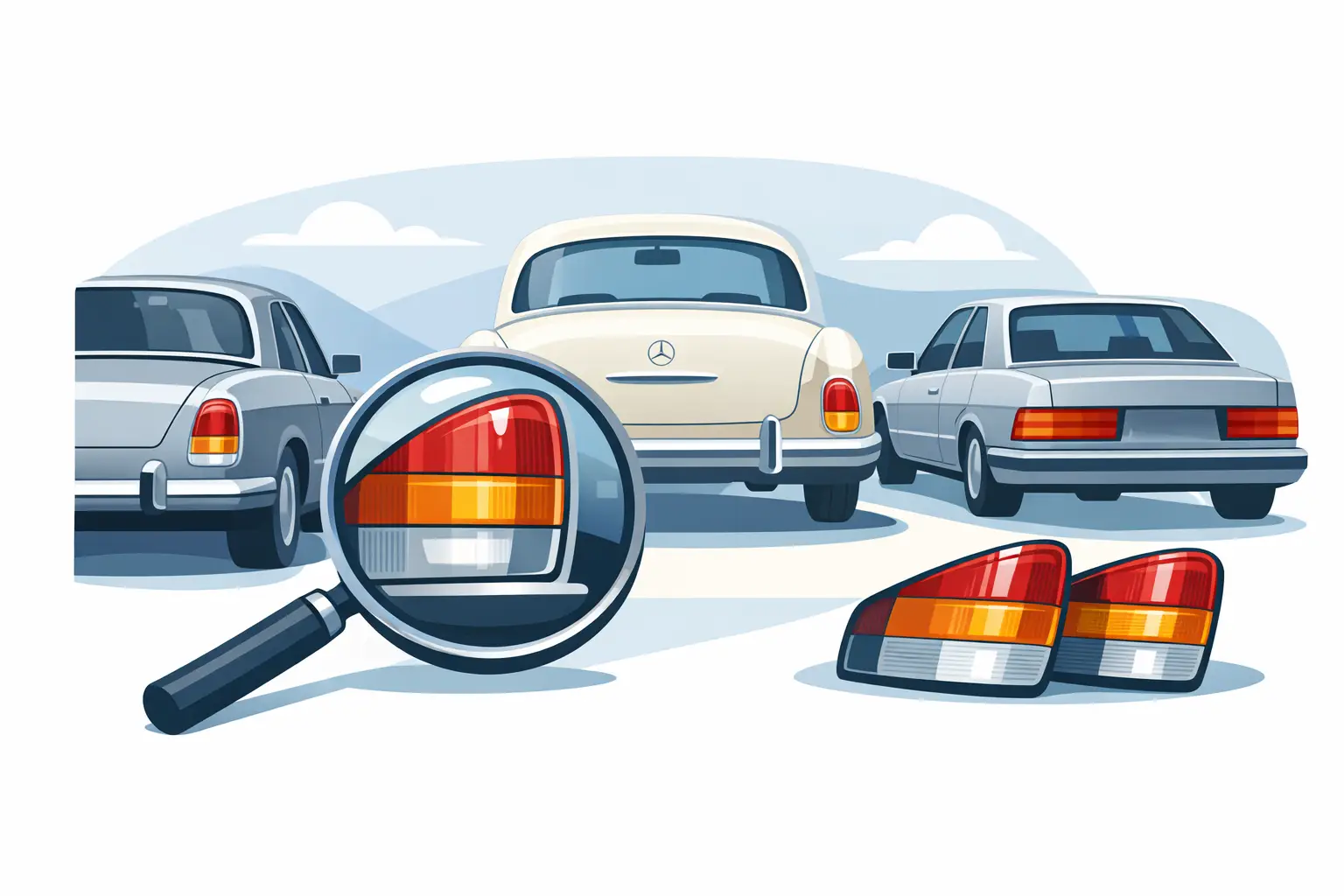
A faded lens, a cracked housing, or the wrong amber-red pattern can throw off an otherwise correct restoration fast. When buyers search for mercedes vintage tail lights, they are usually not looking for a generic replacement. They are trying to match a specific chassis, production range, and factory-correct appearance that fits the car the way Mercedes intended.
For classic Mercedes owners, tail lights sit in that category of parts that seem simple until you start sourcing them. The part has to fit the body cleanly, seal properly, match the trim and lens layout, and look right for the model year. On cars like the W107 SL, W113 Pagoda, W111 coupe and sedan, W124, or W201, the wrong tail lamp can stand out immediately to anyone who knows the platform.
Why mercedes vintage tail lights require chassis-specific sourcing
This is not a universal part category. Mercedes changed lens patterns, reflector sections, gasket profiles, bulb carrier designs, and side-specific housings across generations. Even within one chassis family, there can be early and late differences that matter.
A buyer working on an R107, for example, may need to confirm whether the lamp matches the trim and rear panel shape for the exact production year. A W124 owner may be comparing standard sedan tail lamp assemblies against coupe or wagon variations, where the fitment and lens profile are completely different. On older cars like the W111 or W113, originality matters even more because collectors tend to notice details such as lens tint, chrome surround condition, and whether the lamp reproduces the factory look or appears visually off.
That is why tail lights should be sourced the same way you would source trim, grilles, or interior wood – by chassis code first, then by year range, then by side and configuration. If the listing does not clearly identify fitment, that is a red flag.
What to check before buying Mercedes vintage tail lights
The first checkpoint is the chassis code. Mercedes buyers already know this, but it remains the fastest way to avoid ordering the wrong part. W107, R107, W113, W111, W124, W201, and R129 buyers all face different fitment questions, and the correct answer usually starts with the body code, not just the model name.
The second checkpoint is whether you need a complete assembly, lens only, housing only, or bulb carrier. Many tail light problems are not caused by the outer lens alone. On older Mercedes applications, the gasket may be brittle, the mounting points may be stressed, or the electrical contact plate may be corroded. Replacing only the visible lens may leave the original problem in place.
The third checkpoint is the finish and color layout. Mercedes used very specific lens segmentation, and restorers generally want the correct red, amber, and reverse lens arrangement for the production period. A part that technically bolts on but does not match the original visual pattern can lower the quality of the restoration.
The last checkpoint is left versus right. That sounds basic, but vintage inventory often moves one side at a time. If one tail lamp is damaged and the other is sun-faded, buying only one new assembly can create a visible mismatch. On some restorations, replacing the pair is the better result, even if only one side failed.
Common issues with classic Mercedes tail light assemblies
Sun exposure is the obvious one. UV damage can bleach red sections, haze the lens surface, and make the plastic look dry or chalky. Once that happens, the rear of the car starts looking tired even if the sheet metal and chrome are in good condition.
Cracks around mounting points are also common, especially on cars that have had previous body work or careless removal. A lens may look usable from ten feet away but fail to seal once installed. Water intrusion then starts affecting the housing, bulb sockets, and trunk area.
Electrical age is another issue that buyers sometimes underestimate. On older Mercedes models, tail lamp problems can come from corroded contacts, weak grounds, or damaged bulb carriers rather than the lens itself. If a brake light works intermittently or one side runs dimmer than the other, inspect the full assembly before deciding what to replace.
Seal condition matters too. A vintage Mercedes can have a very clean exterior and still develop moisture problems because the tail light gasket has hardened over time. If you are already removing the assembly, it is smart to inspect the seal and mounting surface instead of treating the lamp as a cosmetic-only part.
OEM-style vs reproduction options
This is where buyer priorities usually split. Some owners want the closest possible factory-correct part for a high-level restoration. Others want a clean, reliable replacement that restores appearance and function without chasing rare original stock.
OEM-style parts are usually the safer choice when fit, lens pattern, and finish quality matter most. They tend to align better with the body, maintain the expected appearance, and reduce the chance of visual inconsistencies. For collector-grade cars, that difference is often worth it.
Reproduction parts can still make sense, but only if the fitment details are clear and the quality is known. The trade-off is straightforward: a lower-cost option may solve an immediate problem, but poor molding, thin plastic, or incorrect color sections can become obvious after installation. On visible exterior parts like tail lights, buyers usually regret cutting corners if the rest of the car is well kept.
Model-specific considerations buyers should keep in mind
W107 and R107 owners often pay close attention to tail lamp clarity and trim alignment because the rear of the SL is visually clean and exposed. A slightly off lamp assembly can stand out against otherwise straight chrome and paint.
W113 Pagoda restorations demand even tighter attention to correctness. These cars attract informed buyers, and rear lighting details matter in a way that generic replacement parts rarely satisfy. If the lens design or fit is off, it shows.
W111 coupe and sedan applications can raise sourcing issues simply because parts are older and availability is tighter. In these cases, condition and authenticity carry more weight than price alone.
W124 and W201 buyers often deal with a different decision. These cars may be driver restorations, enthusiast builds, or collector projects depending on condition and trim. For a clean 190E or E-Class restoration, tail lights need to look period-correct, but practical concerns like good seals, clean contacts, and matching left-right appearance are just as important.
Even on the later R129, buyers usually want a part that preserves the factory rear-end look. Cheap lighting parts tend to look cheap on these cars, especially next to original paint and trim.
How to shop the category without wasting time
Start with the exact chassis and production year, then confirm side, body style, and whether the part is sold as a complete assembly or a component. If you are working from an existing part number, compare it against the application before ordering. Vintage Mercedes fitment is too specific for guessing.
It also helps to be honest about the project level. A high-end restoration, a clean weekend driver, and a resale-focused refresh do not always need the same solution. If the car is collector grade, go for the most correct part you can source. If the goal is a solid driver with proper appearance and reliable lighting, a high-quality OEM-style replacement is often the practical move.
Buyers should also think beyond the lamp itself. If one tail light failed because of age, the opposite side may not be far behind. Matching assemblies, fresh seals, and inspected bulb carriers usually produce a better result than replacing one visible part and leaving the rest untouched.
For shoppers moving quickly through category pages, this is where a specialist inventory makes the difference. A catalog built around classic Mercedes applications saves time because it is organized the way real buyers search – by chassis, by system, and by part type. That is especially useful when you are tracking down hard-to-find lighting parts for older models where generic parts stores are not much help.
When replacement is better than restoration
Some original lamps can be polished, resealed, and put back into service. If the lens is structurally sound and the housing is clean, that can work on a driver. But once you have deep UV damage, visible cracking, broken tabs, or moisture-related internal wear, restoration starts becoming a compromise.
At that point, replacement is usually the cleaner answer. Tail lights are safety parts, but they are also major visual pieces on a classic Mercedes. If the car deserves a proper rear-end finish, a fresh, correctly fitted assembly usually does more for the final result than trying to save a part that is already past its useful life.
If you are shopping mercedes vintage tail lights, the best move is to treat them like any other model-correct exterior component: verify the chassis, check the production fitment, and buy for appearance as well as function. A good tail light should not call attention to itself. It should simply look right, fit right, and let the rest of the car speak for itself.