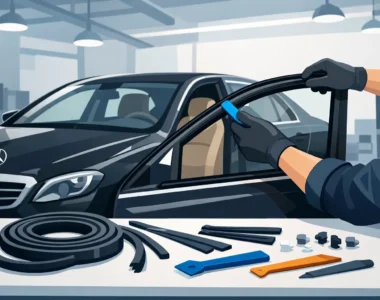

A bent star surround, pitted chrome, or broken grille tabs can change the whole front end of a vintage Mercedes. Classic Mercedes grille replacement is not just cosmetic. On models like the W107, W113, W111, and W124, the grille defines the car’s face, and the wrong part stands out immediately.
For collectors and restorers, the issue is rarely whether to replace the grille. The real question is which grille assembly, insert, surround, seal, and hardware will actually fit the chassis, match the trim level, and look correct once installed. That matters whether you are finishing a driver-quality refresh or correcting details on a higher-end restoration.
Why classic Mercedes grille replacement needs chassis-specific fitment
Grille fitment on classic Mercedes-Benz models is more exact than many buyers expect. Even when two cars look similar from ten feet away, the grille shape, mounting tabs, center star provision, and trim finish can differ by chassis, production range, and market variation.
A W107 SL grille is a different purchase decision than a W113 Pagoda grille, and both are different again from a W111 sedan or coupe assembly. Later cars like the W124 and W201 bring their own fitment considerations, especially where grille shells, inserts, and hood interface points changed across model years. If you are shopping by appearance alone, you can end up with a part that looks close in photos but creates alignment issues at the header panel or hood edge.
This is where serious buyers save time by starting with chassis code first, visual match second. If the grille opening, mounting pattern, or trim profile is even slightly off, the finished result will not read as factory-correct.
What to inspect before ordering a replacement grille
The grille itself may not be the only damaged component. On older cars, impact damage, corrosion, or prior repair work often affects the parts around it. Before ordering, inspect the grille shell, insert, star mount, perimeter trim, grille seal, mounting screws, clips, and the surrounding sheet metal.
If the old grille sits unevenly, the problem may not be the grille alone. A slightly pushed-in radiator support, a repaired hood lip, or missing hardware can all cause poor fitment. Chrome pitting can also mislead owners into replacing only the visible surround when the insert or backing structure is already weakened.
It also helps to decide what level of restoration you are targeting. A weekend driver may justify a clean, high-quality replacement that presents well from normal viewing distance. A collector-grade car usually needs a more exact match in finish, profile, and period-correct construction. On prominent front-end pieces, small differences tend to be more visible than expected.
Check whether you need a full assembly or individual components
Not every classic Mercedes grille replacement means buying a complete grille. Some cars need only the insert. Others need the surround, star, seals, and hardware because years of removals have left broken fastener points or worn trim. Buying component by component can be cost-effective, but only if the remaining pieces are straight and usable.
If the existing shell is bent or the mounting points are fatigued, piecing it together often costs more in the long run. For many restorers, a complete, model-correct assembly is the cleaner solution.
Finish quality matters more than catalog photos suggest
On a classic Mercedes front end, chrome and brightwork quality are hard to hide. A grille with inconsistent finish, weak plating, or visibly soft detail can undermine an otherwise solid restoration. This is especially true on cars with upright grille designs, where the grille is the visual center of the nose.
Photos rarely tell the full story. Buyers should pay attention to construction quality, finish consistency, and whether the part is intended as an authentic-style replacement for the specific chassis. If the vehicle is a known enthusiast platform, exact appearance matters.
Common fitment issues by classic Mercedes model family
Different chassis create different grille replacement problems. On the W113, buyers often focus on the grille face and overlook the importance of correct contour and trim relationship to the front sheet metal. A grille that is even slightly wrong in shape can upset the clean nose profile that makes the Pagoda front end look right.
On the R107 and C107 range, grille replacement can involve more than age-related pitting. These cars often have prior front-end repair history, so even a correct grille may need surrounding alignment checked before installation. On the W111 and W108/W109 families, brightwork correctness is especially visible, and mismatched finish tone between grille components can stand out.
For W124 and W201 buyers, the challenge is often year-specific detail. Mid-cycle changes, trim differences, and model variations can complicate what seems like a simple order. The safest route is always chassis-led identification backed by a visual comparison of the original part.
Classic Mercedes grille replacement and installation planning
Installation is usually straightforward if the correct part is in hand and the surrounding front-end structure is straight. The trouble starts when owners force alignment to make an almost-correct grille fit. That can crack trim, stress mounting tabs, and leave uneven panel gaps.
Before installation, test the new grille against the car without fully tightening hardware. Confirm that the upper and lower mounting points line up, the grille sits square in the opening, and the hood and trim clear correctly. If you need unusual pressure to pull the part into place, stop and recheck fitment. On these cars, resistance often means something is wrong.
Use fresh hardware and seals when needed. Old clips, fatigued screws, and hardened rubber can make a new grille sit worse than the worn part you removed. On a restoration-minded build, reusing compromised mounting pieces is usually false economy.
When repair makes more sense than replacement
Not every original grille should be discarded. If the car retains a genuine factory piece with light damage, straightening or refinishing may be worth considering, especially on harder-to-source applications. Some owners prefer preserving original components where possible, particularly on cars with known provenance or uncommon trim specifications.
That said, repair only makes sense when the base part is structurally sound. Severe corrosion, broken mounts, or poor prior repairs usually make replacement the better answer. The goal is not just to make the grille look acceptable in photos. It is to restore proper fit, finish, and durability.
Buying the right grille for a classic Mercedes the first time
High-intent buyers usually want the same thing: get the correct part once and move on to the next item on the build list. The best way to do that is to shop by exact model application, confirm production compatibility, and review whether the listing covers the complete assembly or only one portion of it.
This is also where specialist inventory matters. A broad multi-brand parts seller may treat grilles as generic exterior trim. A classic Mercedes-focused catalog is far more likely to distinguish between chassis codes, fitment details, and the supporting hardware needed for a proper install. For owners working through restoration punch lists, that saves time and avoids returns.
Mercedes Parts Zone serves this kind of buyer because the search starts with classic Mercedes applications, not generic aftermarket assumptions. If you are sourcing grille parts alongside seals, trim, lighting, and front-end hardware, model-specific catalog organization matters.
What separates a good result from a correct one
A good result is a grille that bolts on and looks decent from the curb. A correct result is one that fits the body lines properly, matches the car’s trim character, and does not raise questions from anyone who knows the chassis. On collectible Mercedes-Benz models, that difference affects presentation and, in some cases, value.
That is why classic Mercedes grille replacement should be treated as a fitment and authenticity purchase, not just a cosmetic one. The right grille restores the front end the way Stuttgart intended. The wrong one becomes the first thing you notice every time you walk up to the car.
If your current grille is tired, bent, or simply incorrect for the chassis, take the extra minute to verify the exact application before you buy. On a classic Mercedes, front-end details are never small details.