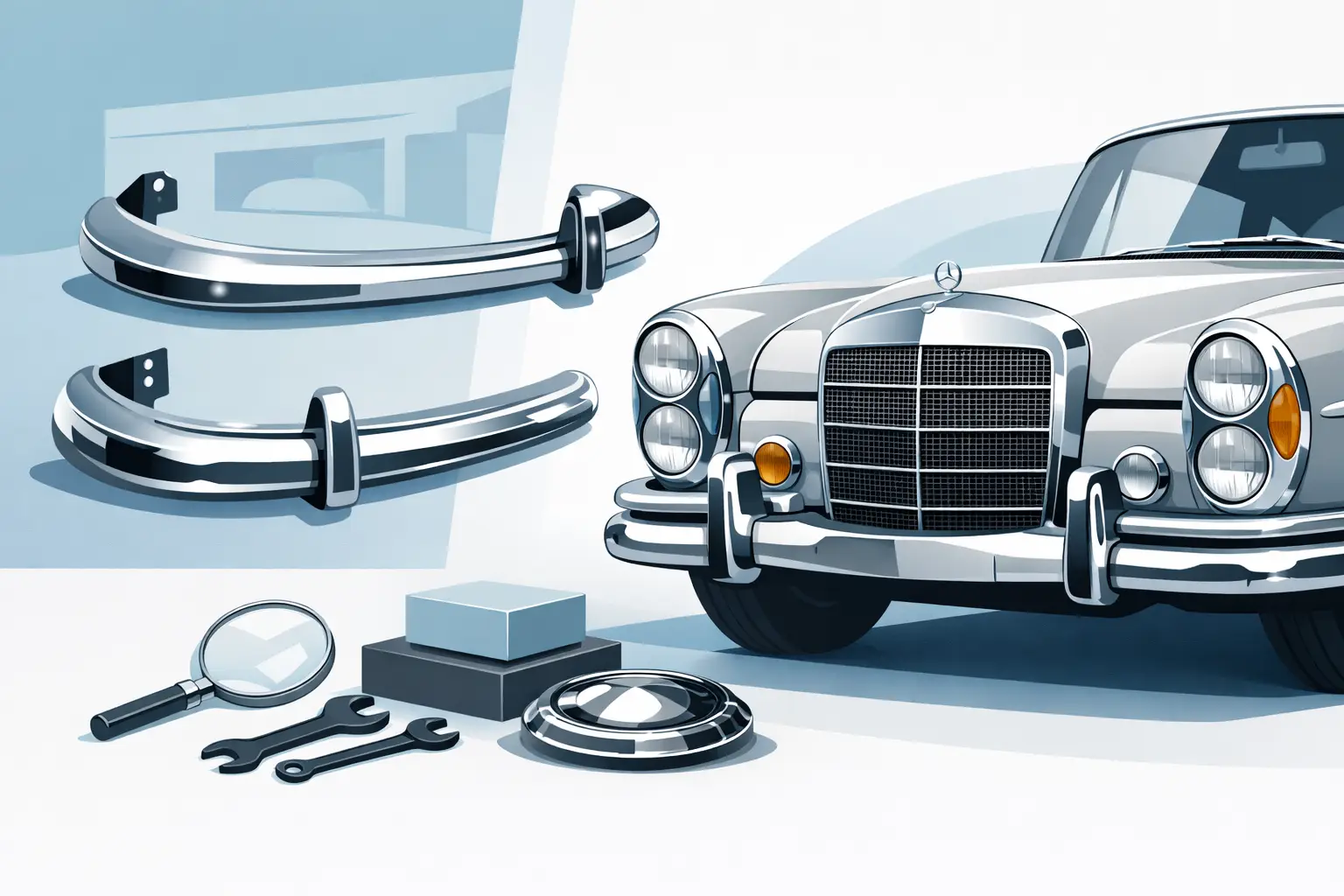
A straight, properly finished w111 chrome bumper changes the whole car. On a W111 coupe or cabriolet, the bumper is not background trim – it defines the front and rear view, frames the body lines, and immediately tells you whether a restoration was done with care or with compromises.
For buyers working on a 220SE, 250SE, 280SE, or 280SE 3.5, bumper selection usually comes down to three things: fitment, finish quality, and model correctness. Price matters, but on a classic Mercedes of this level, a cheap bumper that needs reworking often costs more by the time chrome flaws, bracket issues, and alignment problems are sorted out.
What makes a W111 chrome bumper difficult to buy
W111 exterior trim is deceptively complex. From a distance, many parts look interchangeable. Up close, small differences in contour, mounting points, overrider design, and year-specific details matter. That is especially true on bumpers, where even slight dimensional errors can throw off the relationship between the bumper blade, body corners, guards, and trim.
The challenge is that many owners are not buying for a driver-grade car alone. They are buying for a car with strong collector value, or for a restoration where panel alignment, brightwork consistency, and factory-style appearance are all under scrutiny. A bumper that is “close enough” may still look wrong once installed next to original grille trim, headlamp doors, taillamp housings, and polished body moldings.
There is also the issue of existing damage. On many W111 cars, prior accidents or poor repairs leave bent brackets, distorted mounting surfaces, or uneven panel gaps. That means a new bumper can appear to fit poorly when the real issue is behind it. Buyers need to assess the entire mounting setup, not just the visible chrome piece.
W111 chrome bumper fitment starts with chassis and body style
The first filter is simple but critical – verify the exact W111 application. Coupe and cabriolet buyers already know that body-specific parts can become expensive mistakes when purchased on assumption rather than confirmed fitment. Front and rear bumper assemblies can vary by engine version, production period, and component grouping.
It also helps to think in assemblies rather than single parts. A front bumper is not just one blade. Depending on the setup, you may be dealing with the main section, corner sections, overriders, rubber inserts if applicable, brackets, mounting hardware, and finishing pieces. Rear bumpers bring the same issue, especially when prior owners have mixed original and replacement parts over the years.
If you are replacing one damaged section on an otherwise original car, matching the existing chrome tone and contour matters. If you are restoring the full car, buying the complete set at the same quality level usually produces a better result than mixing one premium section with older worn pieces.
Front versus rear bumper concerns
Front bumper fitment tends to get more attention because it sits under the grille and headlamp area, where visual alignment is obvious. A slightly off front bumper can create an uneven reveal at the fenders or a nose-down look that stands out immediately.
Rear bumper issues are often more subtle until installation. Trunk alignment, quarter panel shape, and exhaust clearance can all affect how the rear assembly sits. On a W111 cabriolet or coupe, that rear view is too important to ignore, so rear bumper tolerances deserve the same level of checking as the front.
Chrome quality is more than shine
A bumper can look impressive in product photos and still disappoint on the car. For restoration-minded W111 owners, chrome quality means surface preparation, plating consistency, edge finishing, and long-term durability. Deep shine is part of it, but not the whole story.
The best results come from smooth base metal, clean contour lines, and plating that looks even across the full length of the part. Waves, ripples, dull spots, or thin areas around bends usually become more obvious once the bumper is mounted in direct light. Since W111 bodywork has elegant, uninterrupted lines, any imperfection in the chrome tends to stand out.
Buyers should also pay attention to the backside and mounting points. A good visible finish does not help much if the mounting areas are poorly formed, weak, or prone to corrosion. On a heavy, valuable classic Mercedes, structural confidence matters just as much as cosmetic quality.
Rechromed original versus replacement production
This is where “it depends” becomes the honest answer. An original Mercedes bumper core that has been repaired and rechromed can offer excellent fit because the underlying stamping started with factory dimensions. But the quality of the restoration work matters enormously. A poorly straightened original core can still carry old damage under fresh plating.
A new replacement bumper can be a smart option if the manufacturing quality is consistent and the fitment is known to be correct for the specific W111 application. The benefit is often cleaner metal and less uncertainty about old repairs. The trade-off is that not every reproduction has the same contour accuracy as an original part.
For serious buyers, the right question is not whether original is always better or reproduction is always better. The right question is which option gives the most correct fit, finish, and durability for the exact car being restored.
Buying a W111 chrome bumper for a driver or a show-level car
A driver-quality W111 may not need concours-level plating, but it still needs proper fit and clean presentation. If the car is used regularly, many owners prioritize a bumper that installs correctly, holds up well, and presents strongly from normal viewing distance. That is a reasonable approach, especially on cars maintained for road use rather than formal judging.
A high-level restoration is different. On a show-oriented 280SE coupe or 280SE 3.5 cabriolet, bumper quality is part of the car’s credibility. The finish has to work with the grille shell, window trim, side moldings, and lighting surrounds. If one chrome element looks noticeably brighter, flatter, or less precise than the rest, experienced buyers will spot it immediately.
That is why product selection should match the project level. Overbuying can waste budget, but underbuying on visible exterior trim often leads to replacement later. On W111 cars, that usually means paying twice.
What to inspect before installation
Before final mounting, test-fit everything loosely. Do not tighten one side fully and force the other side into place. W111 bumpers need to be centered and checked against the body as a complete assembly.
Look at the gap to the body, the angle of the bumper relative to the fenders or quarter panels, and the position of overriders and trim pieces. Confirm that brackets are straight, hardware is appropriate, and no old collision damage is affecting alignment. A bumper that seems “off” by a quarter inch may be telling you about a bent support, not a bad chrome part.
It also makes sense to protect fresh chrome during installation. These parts are bulky, and one slip with a wrench or bracket edge can mark the finish. On a W111 restoration, avoiding preventable damage is part of doing the job once.
Where specialized sourcing matters
A general classic parts seller may list a Mercedes bumper, but that does not mean the listing reflects W111-specific reality. Fitment questions on these cars often come down to exact chassis knowledge, body style awareness, and understanding of how Mercedes trim assemblies are actually built.
That is where a specialized source makes a difference. Buyers shopping through a focused catalog are better positioned to identify model-correct exterior parts, compare related hardware, and avoid generic replacement inventory that treats all classic Mercedes applications as basically the same. For owners who want fast identification and fewer returns, that matters. Mercedes Parts Zone serves that need with a catalog built around chassis-specific classic Mercedes inventory rather than broad multi-brand guesswork.
Price, value, and avoiding the wrong compromise
A low price on a w111 chrome bumper can be attractive, especially when restoration costs are piling up across paint, interior, suspension, and trim. But bumper value should be measured by the full job cost, not by the purchase price alone. If the chrome is thin, the contour is wrong, or installation requires extensive correction, the savings disappear quickly.
The better buying decision is usually the part that gets you closer to correct fitment, strong finish, and fewer surprises during assembly. That is especially true on W111 coupes and cabriolets, where exterior presentation carries a lot of the car’s value.
If you are shopping for a bumper now, start with exact fitment, confirm the full assembly you need, and buy to the level of the car rather than the lowest number on the screen. A W111 deserves brightwork that looks right from every angle and stays that way after the car is back on the road.