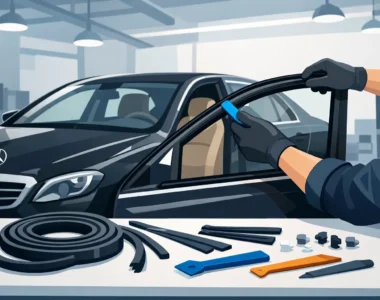
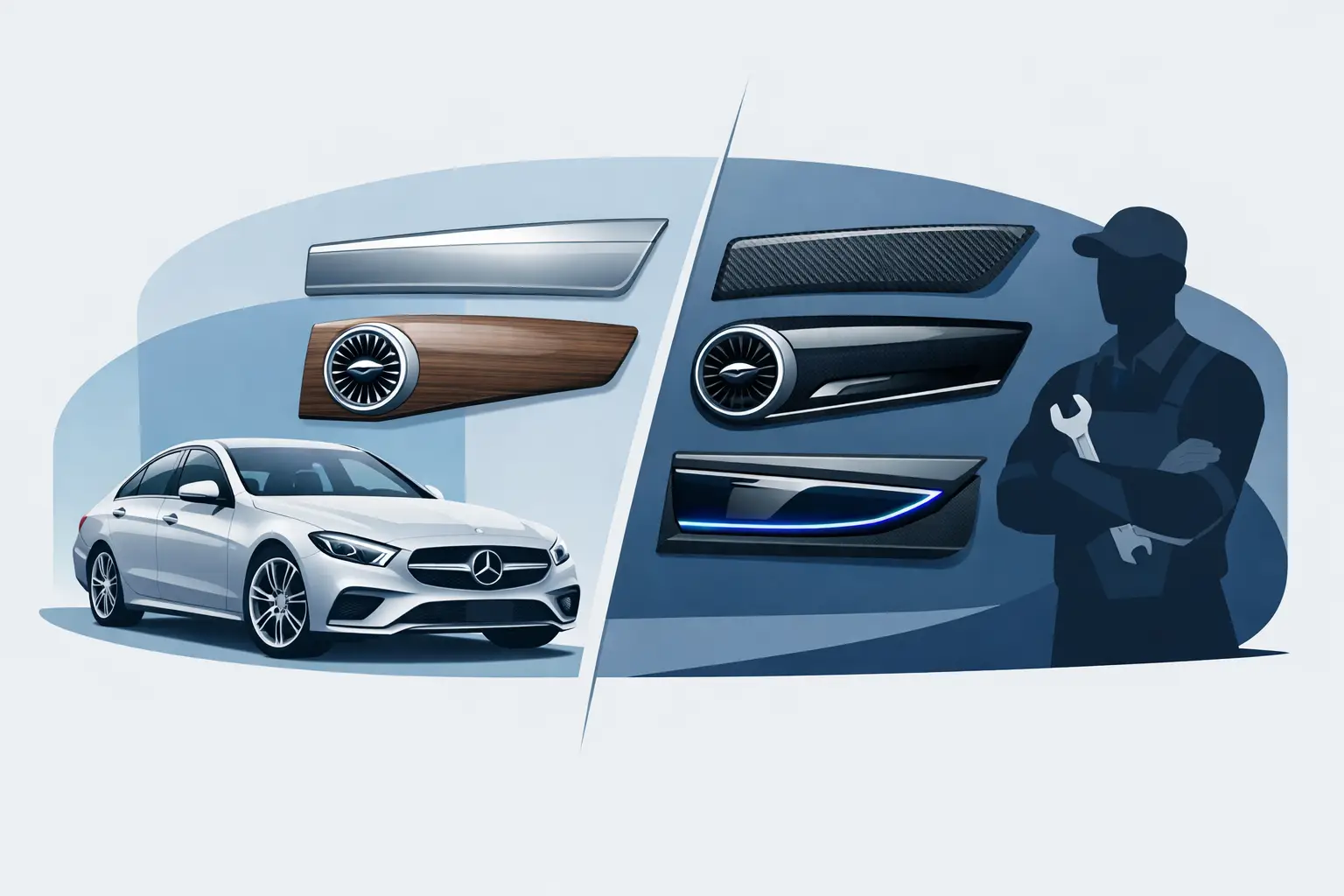
A trim piece can make or break the look of a classic Mercedes. On a W113, one mismatched brightwork section stands out immediately. On an R107 or W124, poor fit around a grille surround, rocker molding, or window trim is often the first sign that the car was repaired with the wrong parts. That is why the oem vs aftermarket mercedes trim question matters so much – especially if you care about model-correct restoration, resale value, and long-term fit.
For classic Mercedes owners, trim is not just cosmetic. It affects panel alignment, weather sealing, attachment strength, and the overall impression of quality that these cars are known for. The right decision depends on the chassis, the specific part, and what standard you are trying to meet.
OEM vs aftermarket Mercedes trim: what changes in the real world
OEM trim is built to Mercedes-Benz specifications for the original application. On older models, that usually means correct dimensions, proper finish, and hardware or attachment points that match factory mounting locations. If you are restoring a W111 coupe, replacing R129 side trim, or sourcing W201 exterior moldings, OEM is usually the benchmark for consistency.
Aftermarket trim covers a wide range. Some pieces are decent driver-quality replacements. Others are generic reproductions with visible differences in profile, finish, thickness, or mounting method. In the classic Mercedes market, aftermarket quality is rarely uniform across brands or across part types. A reproduction rubber insert may be acceptable, while a reproduction chrome surround may be noticeably off the moment it is installed.
That difference is what trips up a lot of buyers. The label aftermarket does not automatically mean bad, and OEM does not automatically mean easy to source or reasonably priced. On classic chassis, it often comes down to how visible the part is, how difficult it is to fit, and how correct the car needs to be.
Fitment is where OEM usually wins
Fitment is the main reason restorers stay with OEM trim whenever possible. Mercedes trim parts were designed around exact body contours, clip spacing, and factory tolerances. On cars like the W107 SL, even a slight variation in curvature can leave a gap at the fender edge or force tension into the part that shortens its lifespan.
Aftermarket trim can look acceptable on the bench and still create problems during installation. Mounting holes may sit a few millimeters off. Clips may not lock cleanly. The cross-section of the molding may be too shallow or too tall. On body side trim and window surrounds, those small differences become obvious once the piece is next to original trim on the rest of the car.
This is especially relevant for partial repairs. If you are replacing one damaged piece rather than re-trimming the whole car, OEM is far more likely to match the adjacent original parts. A single aftermarket strip on an otherwise original W124 or W201 often looks exactly like what it is – a substitute.
Finish and material quality matter more than many buyers expect
Classic Mercedes trim has a particular look. Brightwork should have the right luster, anodized aluminum should not look overly polished, and black trim should not fade to a chalky finish within a season. Material quality affects all of that.
OEM trim generally holds the edge in finish consistency and substrate quality. Chrome-plated or polished surfaces tend to have better depth and uniformity. Plastic trim usually has more accurate grain, color, and UV stability. Rubber-backed or insert-type trim often fits more cleanly and ages more predictably.
Aftermarket parts vary. Some are made from thinner metal, softer plastic, or lower-grade coatings. That may not matter on a hidden retainer or a lower-priority driver part. It matters a great deal on a grille molding, beltline trim, wheel arch trim, or any piece that catches light across the side of the car.
On collector-grade cars, finish mismatch is one of the fastest ways to lose the factory appearance. That is why serious buyers tend to spend more on visible exterior trim and save the compromises for less noticeable parts.
When aftermarket Mercedes trim makes sense
There are cases where aftermarket trim is the practical choice. Some OEM parts are discontinued, hard to source, or priced at a level that does not make sense for the car’s use. If you are maintaining a driver-grade R107, a non-concours W126, or a project W201 that needs multiple cosmetic corrections, a quality aftermarket piece can be the right move.
It also makes sense when the part is low-visibility and low-risk. Small interior finishing pieces, clips, seals paired with trim, or trim inserts that do not define the entire appearance of the panel can sometimes be replaced successfully with aftermarket alternatives. The key is being selective, not assuming every reproduction part is suitable just because it is available.
Budget matters too. Many owners would rather get the car complete and presentable now than wait months for a rare OEM molding. That is a reasonable approach, especially if the car is being enjoyed rather than judged. The mistake is treating all trim the same. A lower door edge strip and a Pagoda windshield surround do not carry the same visual weight.
OEM vs aftermarket Mercedes trim for restoration value
If originality is a major goal, OEM trim usually supports stronger resale and better buyer confidence. Collectors notice details. They check body gaps, trim profile, finish quality, and whether moldings sit correctly against the panels. On high-value classic Mercedes models, trim correctness is part of the overall authenticity story.
This matters most on cars like the W113, early SL models, coupes, cabriolets, and limited-production enthusiast chassis. Buyers paying serious money tend to prefer factory-correct parts because they reduce questions about prior repairs, quality of workmanship, and long-term parts integrity.
For a driver, the equation can be different. If the car is mechanically strong, visually honest, and not positioned as a top-tier restoration, aftermarket trim may have little effect on your enjoyment. But if resale is in the back of your mind, visible shortcuts often cost more later than they save up front.
How to choose the right trim part for your chassis
Start with the part’s visibility. If it sits at eye level, frames glass, outlines a grille, or runs the length of the body, lean OEM. Those areas define how the car presents. Errors are easy to spot and hard to ignore.
Next, consider installation complexity. If the trim is difficult to install, removing it later because the reproduction part fits poorly can double your labor cost. This is common with clips, channel-mounted trim, and pieces installed near paint or glass. On those parts, buying once is usually cheaper than buying twice.
Then look at the purpose of the car. A concours-level W111 restoration deserves a different standard than a weekend W124 driver. If the car is being built for long-term ownership and correctness, OEM trim is usually the safer investment. If you are reviving a usable car and the part is not highly prominent, a vetted aftermarket option can be perfectly reasonable.
Finally, verify chassis-specific compatibility. Mercedes trim is often application-specific down to body style, production range, and market variation. A part that is close is often not close enough. W107, R129, W124, and W201 owners already know that trim differences between years and submodels are not minor details.
The smartest buying approach for classic Mercedes owners
For most classic Mercedes projects, the best strategy is mixed, not absolute. Use OEM for high-visibility exterior trim, difficult-fit parts, and anything that affects originality. Consider aftermarket only where quality has been proven, the part is less visible, or OEM supply is unrealistic.
That approach keeps the car looking right without overspending in the wrong areas. It also reflects how experienced restorers actually buy parts. They do not choose based on price alone. They choose based on what the part does, where it sits, and whether a mismatch will bother them every time they walk up to the car.
At Mercedes Parts Zone, that is the same standard many classic Mercedes owners use when sourcing model-specific components – buy the part that fits the car, the finish level, and the restoration goal.
If you are deciding between OEM and aftermarket trim, be honest about the car you are building. The right answer is usually visible in the part itself: if it defines the lines of the car, it deserves more than a maybe.