
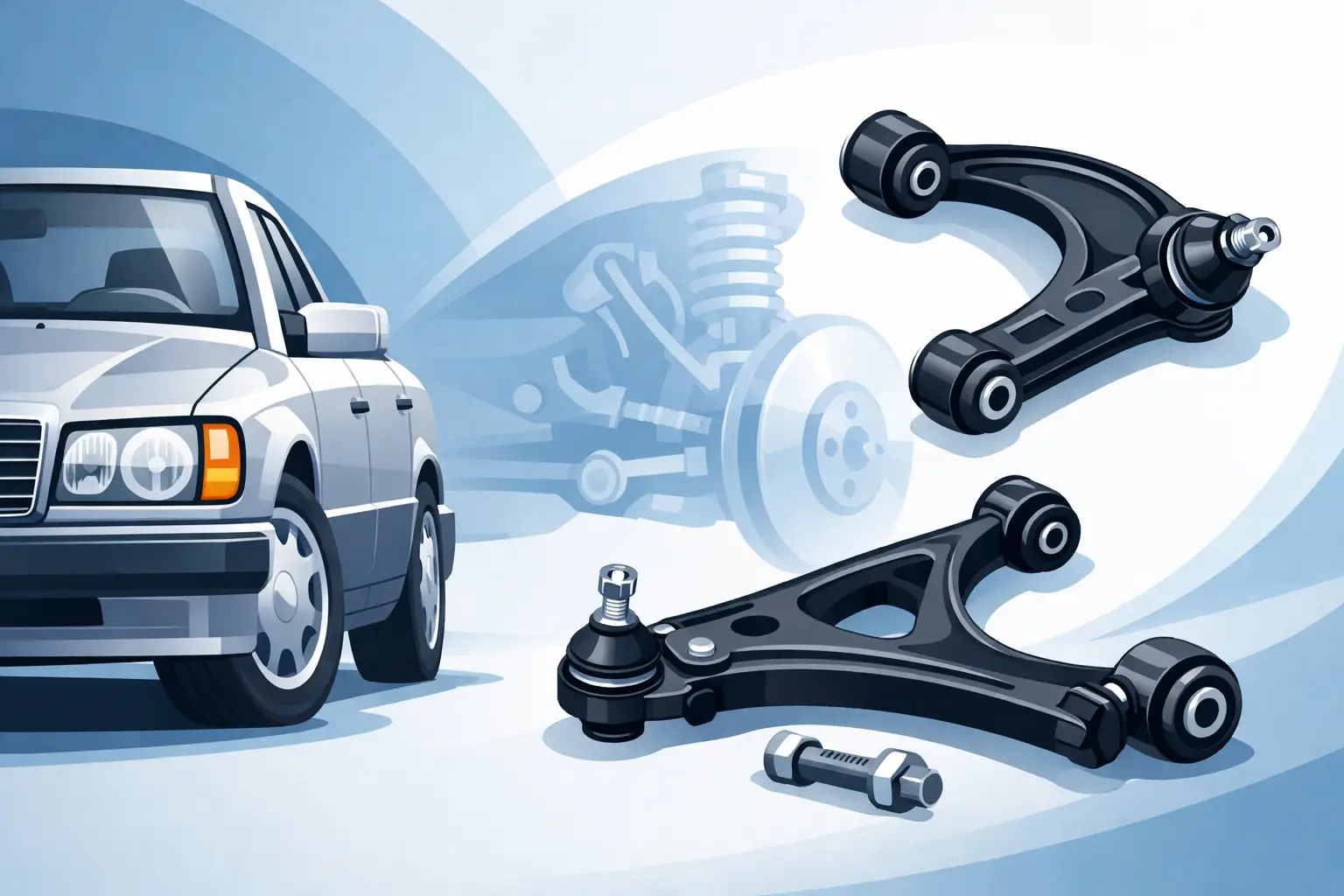
A W124 with tired front-end hardware does not hide it well. The steering gets vague on center, the car follows grooves it used to ignore, and the front suspension starts adding small noises over bumps that were never part of the original Mercedes feel. In this review Mercedes W124 control arms are worth looking at as more than simple wear items, because the right arm changes how the car tracks, brakes, and settles at highway speed.
What matters in a review Mercedes W124 control arms buyers can actually use
On the W124, the lower control arm is not just a metal arm with a ball joint attached. It is a key load-bearing suspension component that affects alignment stability, steering precision, braking behavior, and front tire wear. If you are restoring an E-Class sedan, coupe, wagon, or cabriolet, the quality gap between control arm options shows up quickly after installation.
Most buyers are really comparing three things: arm construction, bushing quality, and ball joint durability. Price matters, but the cheapest option often costs more once labor, alignment, and repeat replacement are factored in. On a chassis as well-engineered as the W124, poor suspension parts are easy to feel.
Why W124 control arms fail
Mercedes designed the W124 front suspension for stability and comfort, but these cars are decades old now. Even if the arm itself is structurally sound, the bonded rubber bushings harden, crack, or separate with age. Ball joints develop play, boots split, grease escapes, and the front end starts moving in ways it should not.
Climate and use matter. A low-mileage Arizona car may have dry and brittle rubber, while a Midwest car may show corrosion and joint wear from road salt. Cars with oversized wheels or neglected shocks also place more stress on suspension joints and bushings. That is why mileage alone does not tell the full story.
OEM-style versus budget aftermarket
If you are shopping for W124 control arms, the market usually splits into OEM, OEM-supplier, and low-cost aftermarket replacements. The difference is not marketing language. It is in the casting quality, machining tolerances, bushing compound, and how closely the geometry matches original Mercedes specifications.
OEM or high-grade OEM-supplier control arms generally deliver the fit and steering feel owners expect. Mounting points line up correctly, the ball joint seats properly, and the rubber bushings do not feel overly soft or artificially stiff. For drivers who want the car to retain its factory character, this is usually the safest buy.
Budget aftermarket arms can be tempting, especially when a full front suspension refresh is already expensive. Some are serviceable for a lower-mileage weekend car, but many introduce trade-offs. The most common problems are premature bushing fatigue, inconsistent ball joint quality, and a front-end feel that is slightly off even when alignment specs are technically correct. On a W124, that subtle loss of composure is noticeable.
Fitment is not a small detail on the W124
The W124 range includes multiple body styles and engine variations, and part selection is not always as simple as choosing by model year. Sedan, wagon, coupe, and cabriolet applications can differ. Engine weight and suspension package can also affect compatibility, so chassis-specific fitment matters.
This is where many buyers get burned by generic catalog listings. A control arm that is close enough on paper can still create problems at installation or alter the way the front suspension loads under braking and cornering. If you are ordering parts for a 300E, 400E, E320, 500E, or wagon, confirm the exact application before you buy. Serious W124 owners know that correct fitment is part of quality.
How good control arms should feel on the road
A proper control arm replacement should not transform the W124 into something sporty and harsh. That is the wrong target. What you want is the return of the original Mercedes front-end character – stable, quiet, planted, and controlled.
With quality control arms installed, the steering should feel cleaner on center and more predictable through long sweepers. Brake dive may still exist because that is part of the chassis tuning, but the front end should not wander or shift under load. Over broken pavement, the suspension should absorb impacts without adding clunks, looseness, or after-movement.
If the car still feels unsettled after replacement, look beyond the arms. Tie rods, guide rod mounts, idler arm bushings, sway bar links, and shocks all interact with front suspension behavior. A W124 rarely benefits from replacing one worn item in isolation.
Ball joints and bushings – where quality shows up first
In any honest review Mercedes W124 control arms should be judged first by the wear items already attached to the arm. The bushings control fore-aft and lateral movement. The ball joint manages articulation while keeping the wheel located correctly. If either component is substandard, the part may bolt in fine and still disappoint within a short period.
A good bushing should have the right compliance for a heavy, refined chassis. Too soft, and the front end can feel delayed or floaty. Too hard, and the ride becomes sharper without delivering the precision you expected. The best W124 control arms keep that factory balance.
Ball joints are even less forgiving. Excessive play affects safety, alignment consistency, and tire wear. On a car that may still see interstate speeds, there is no reason to gamble on unknown joint quality. That is especially true if you are already paying for installation and alignment.
Is it better to replace the whole arm or press bushings separately?
That depends on the condition of the existing arm and the goal of the repair. If the original arm is in excellent shape and you have access to the right tools, separate bushing service can make sense. It may preserve original hardware and satisfy a more restoration-correct approach.
For many owners and independent shops, a complete control arm assembly is the more practical choice. You save labor, avoid pressing errors, and replace the ball joint at the same time. On a driver-grade W124, this is often the smarter route. On a concours-level restoration, the answer can be different.
When premium parts are worth it
Not every W124 needs the most expensive suspension parts available. A lightly used car that sees short local drives may tolerate a mid-tier option better than a high-mileage daily driver. But if the car is a highway cruiser, a long-term keeper, or a properly restored example, premium control arms are usually money well spent.
The labor is the deciding factor for many buyers. Replacing control arms, then paying for another alignment because a cheap part failed early, is false economy. If you are doing the job once and want it done correctly, buy to the standard of the car.
For buyers sourcing parts through a specialist such as Mercedes Parts Zone, the advantage is straightforward – model-specific inventory and a catalog built around actual Mercedes applications rather than generic multi-brand listings. That matters when the goal is fitment confidence, not just a low number at checkout.
What to inspect before and after installation
Before ordering control arms, inspect tire wear, steering linkage, shocks, spring pads, and front subframe mounts. Uneven wear patterns and vague steering are not always caused by the control arms alone. If the surrounding components are just as worn, new arms will only solve part of the problem.
After installation, the car needs a proper alignment. That is not optional. Even the best control arm will not perform correctly if toe and camber are left unchecked. It is also smart to recheck torque and inspect bushing position after some initial driving, especially on a car that sat for years before returning to the road.
Final buying take
If you are shopping carefully, the best review standard for Mercedes W124 control arms is simple: correct fitment, OEM-style geometry, durable bushings, and ball joints you would trust at 80 mph. Anything less works against what makes the W124 worth preserving in the first place.
Buy for the chassis, not just the price point. When the front suspension is right, a W124 reminds you why Mercedes got this platform so right the first time.


1 Comment