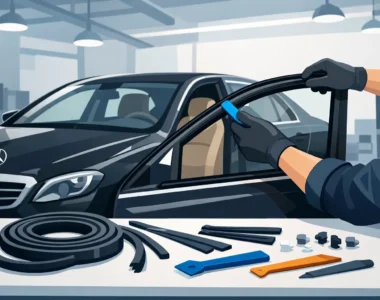

A classic Mercedes with tired seals tells on itself fast. Wind noise at 55 mph, damp carpets after a wash, trunk odors in the cabin, and doors that need a second slam usually point to the same issue. If you are shopping for the best classic Mercedes weatherstrip kits, the real question is not just who sells rubber. It is which kit matches your chassis, your restoration standard, and the way the car is actually used.
What separates the best classic Mercedes weatherstrip kits
On older Mercedes-Benz chassis, weatherstripping is not a generic maintenance item. It affects door alignment, glass seating, cabin noise, water management, and how finished the car feels when it closes up. A poor seal can make an otherwise strong W107 or W124 feel loose, while a correct seal restores the bank-vault character these cars are known for.
The best classic Mercedes weatherstrip kits get three things right. First is fitment by chassis and body style. A coupe, sedan, cabriolet, and hardtop can look similar from ten feet away, but the seal profiles and lengths are often different. Second is rubber quality. Material that is too soft can compress early and leak. Material that is too hard can create closing issues and never seat properly. Third is completeness. A kit should make clear whether it includes door seals, trunk seals, hood seals, top seals, window channel pieces, or secondary body gaskets.
That last point matters because many buyers think they need a full kit when they only need two or three primary seals. Others order only a main door seal and leave flattened striker, vent, or trunk seals in place, then wonder why the car still whistles or smells like fuel.
Best classic Mercedes weatherstrip kits by chassis
The best kit is always the one built around the exact car, not the broadest catalog description. Chassis-first shopping avoids most return and fitment problems.
W107 and R107 SL models
For the R107, weatherstrip buying gets complicated quickly because coupes and roadsters have different priorities. On an SL, the top-to-body sealing surfaces, door perimeter seals, and hardtop mating seals all affect noise and water entry. If the car has both a soft top and a removable hardtop, there are multiple sealing systems in play, and replacing only one set may not solve the issue.
The best classic Mercedes weatherstrip kits for the R107 usually focus on door seals, trunk seals, hood seals, and top interface seals as separate groups. That is a good thing. It lets owners stage the job rather than overbuy. On higher-end restorations, model-year changes and top configuration need to be checked closely before ordering.
W113 Pagoda
A W113 needs precision more than bulk. Pagoda owners are usually not looking for a one-size-fits-all package. They want seals that sit correctly around the hardtop, door opening, and trunk aperture without creating proud edges or forcing panel adjustment.
For these cars, the best kits are the ones that clearly identify body location and top configuration. A lower-priced set that skips profile accuracy can create more labor than it saves. On a Pagoda, bad rubber fit is obvious.
W111 coupe and cabriolet
W111 weatherstripping is one of those categories where body style matters as much as chassis code. Coupe and cabriolet parts often get mixed in searches, and that leads to wasted time. The best classic Mercedes weatherstrip kits for W111 applications are explicit about pillarless body details, glass contact points, and whether the car is a coupe or open car.
Because these cars rely heavily on clean glass-to-seal contact, seal shape and density matter more than many buyers expect. If the windows are adjusted correctly but wind still gets in, the rubber profile is often the real problem.
W124 and W201
On W124 and W201 cars, buyers are often balancing originality against practical use. These are enthusiast chassis, but many are still driven regularly. That changes the buying decision. A full restoration-grade package may be right for a 500E or low-mile 190E 2.3-16, while a driver may only need the highest-wear seals first.
For these later classics, the best weatherstrip kits are usually the ones broken into logical sections – front doors, rear doors, trunk, hood, sunroof, and body opening seals. That lets owners address leaks methodically without replacing parts that are still serviceable.
What a quality kit should include
A serious buyer should expect more than a vague promise of fit. Good listings identify the application clearly, note whether components are OEM, OEM-style, or reproduction, and explain what is and is not included.
A worthwhile kit may include primary door opening seals, trunk perimeter seals, hood-to-body seals, and model-specific upper or glass-adjacent pieces. Convertible and hardtop cars may also need header seals, A-pillar seals, hardtop base seals, and side window contact strips. If those are sold separately, that is not necessarily a drawback. In many cases, it is more accurate.
This is where a specialist catalog has an advantage. Mercedes owners are better served by product listings organized around W107, W113, W111, W124, W201, and R129 applications than by broad aftermarket fitment tools that flatten every model into the same menu.
OEM, OEM-style, or reproduction
There is no single right answer here. It depends on the car and the goal.
If you are restoring a collector-grade car, OEM or high-grade OEM-style weatherstripping is usually the safer buy. The fit is more likely to match original compression and panel gaps, and the finish tends to look right once installed. That matters on visible areas around doors, vent windows, and hardtops.
If the car is a driver, a quality reproduction can make sense, especially for secondary seals or hard-to-source applications. The trade-off is consistency. Some reproduction rubber fits well enough and lasts, while some comes in with incorrect corners, a shiny finish, or compound hardness that changes how the car closes. Saving money up front can turn into extra labor, adhesive work, or repeated door adjustment.
Common mistakes when buying weatherstrip kits
The biggest mistake is ordering by model name instead of chassis and body style. “280SL” by itself is not enough. A W113 280SL and an R107 280SL are entirely different jobs. The same problem shows up with W111 and W112 searches, or early and late production changes within a single line.
The second mistake is assuming every leak is the main perimeter seal. On many cars, the real issue is a flattened trunk seal, hardened vent window rubber, sunroof drain-related sealing, or top alignment on roadsters. Replacing the wrong seal set first is common.
The third mistake is ignoring installation load. Fresh rubber changes closing pressure. Doors may sit proud for a short period, latches may need minor adjustment, and tops may need careful alignment. That does not always mean the parts are wrong. It can simply mean new, properly dense material is replacing forty-year-old compressed rubber.
How to choose the right kit for your car
Start with the exact chassis, body style, and model year. Then decide whether your priority is concours-level correctness, a strong driver-quality refresh, or solving a specific leak or noise complaint. That decision will narrow the catalog faster than price alone.
Next, inspect the whole sealing system before ordering. Check door openings, trunk, hood, fixed glass edges, top seals, and any visible flattening or tears. On coupes and convertibles, also look at glass alignment. New seals will not compensate for badly adjusted windows.
After that, buy in stages if needed. Primary body opening seals usually deliver the biggest improvement first. Secondary items can follow. This approach is often more effective than buying a large mixed kit with pieces you do not need yet.
For buyers who want model-correct inventory without sorting through generic aftermarket listings, Mercedes Parts Zone is built around classic chassis-specific sourcing, which is exactly what weatherstrip shopping requires.
When a full kit is worth it
A full kit makes sense during paintwork, glass-out restoration, or major disassembly. If the car is already apart, replacing all aged rubber at once avoids duplicated labor and gives the finished car a more uniform fit and appearance. It also helps when the existing seals are equally aged across the vehicle.
If the car is assembled and mostly sound, targeted replacement is often smarter. Door seals and trunk seals can transform the car without forcing a full weatherstrip project. That is especially true on driver-grade W124s, W201s, and R107s where the goal is better use, not a full shell restoration.
The best classic Mercedes weatherstrip kits are the ones that respect the chassis, not just the sale. If the listing is precise, the material is right, and the kit matches how you actually use the car, the payoff is immediate every time you shut the door and hear the car seal the way it should.