
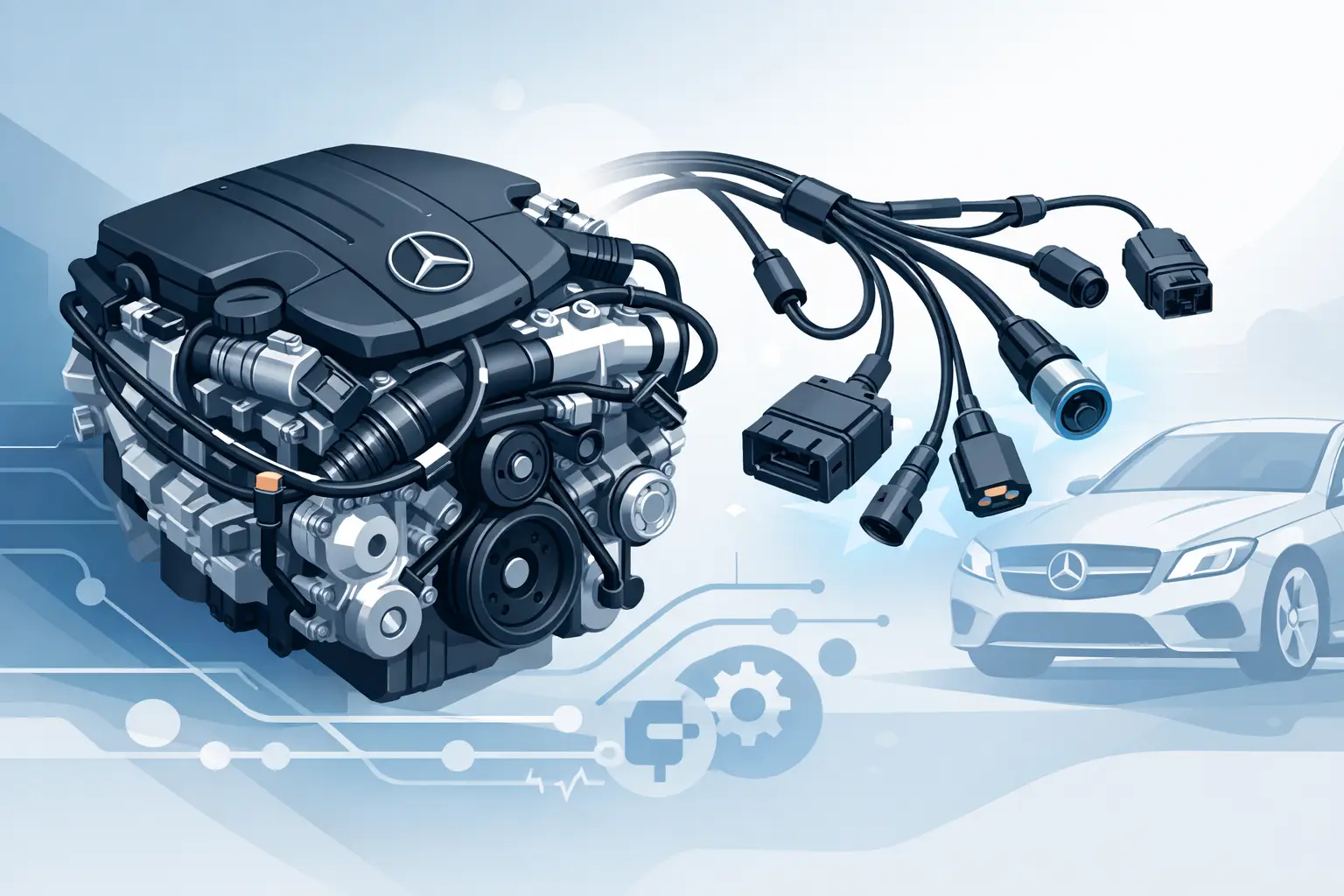
A failing mercedes engine wiring harness usually does not announce itself with one obvious symptom. On classic and late analog-to-early electronic Mercedes models, it often starts with small electrical faults that look unrelated – rough idle, intermittent no-start, injector issues, false sensor readings, or trouble codes that point in three different directions at once. For owners of W124, R129, W140, and related chassis, the harness is not a minor detail. It is a core engine management component, and when the insulation breaks down, diagnosis can get expensive fast.
What the Mercedes engine wiring harness actually does
The engine wiring harness is the dedicated electrical loom that connects engine sensors, injectors, ignition components, throttle systems, and control units. In practical terms, it is the pathway that allows the engine management system to see what the engine is doing and respond correctly. If that pathway is compromised, the car may still run, but it will not run as intended.
On many Mercedes-Benz applications from the late 1980s through the 1990s, harness condition matters as much as the sensor or actuator itself. A perfectly good coolant temperature sensor, mass air meter, throttle body, or ignition component can appear defective if the wiring between that part and the control unit has deteriorated. That is why experienced technicians often check harness integrity early, not late.
Why these harnesses fail on classic Mercedes models
Mercedes owners already know there are certain chassis and engine families where harness degradation is not random wear. It is a recognized age-related failure. Heat cycling, oil exposure, and the insulation material used during that era can lead to cracking, brittleness, and exposed conductors.
This is especially relevant on M104, M119, and some M111-equipped cars, where engine bay temperatures and age work together against the original wiring. Once insulation begins to crumble, wires can short against each other or to ground. The result may be intermittent at first, which makes the problem easy to misread. One day the car has a rough idle. The next day it throws transmission-related behavior, throttle response issues, or a persistent check engine light.
It depends on how far the deterioration has spread. Some harnesses fail in localized sections near the hottest parts of the engine, while others are brittle end to end. A visual inspection can reveal obvious damage, but not always. Sometimes the outer loom still looks acceptable while the individual wire insulation underneath is already breaking apart.
Common signs your Mercedes engine wiring harness is failing
The pattern matters more than any single symptom. If your car suddenly develops multiple sensor faults, inconsistent drivability issues, or electrical gremlins that do not stay fixed after parts replacement, the harness should move high on the list.
Hard starting, unstable idle, random stalling, poor fuel delivery signals, injector misfire behavior, and erratic throttle response are common signs. On some cars, transmission shifting complaints or limp-home behavior can appear because the control modules are receiving corrupted signals. You may also see brittle wiring near injector connectors, coil plugs, cam sensors, or throttle body connections.
Burnt smell, cracked insulation, and exposed copper are obvious warnings, but the more costly situation is when the damage is hidden and the owner keeps replacing sensors that were never the real problem. That is where a model-correct replacement harness saves time as much as money.
Fitment matters more than buyers think
A mercedes engine wiring harness is not a universal electrical part. It is chassis-specific, engine-specific, and often production-range specific. Connector style, wire length, branch routing, shielding, and plug count can vary even within the same broad model family.
That matters on cars like the W124, where an E320 may look straightforward on paper but still require confirmation by engine type, model year, and equipment configuration. The same goes for SL, S-Class, and E-Class applications where running changes occurred over time. Early and late production cars can differ enough that ordering by model name alone is risky.
For restorers and serious owners, this is where OE-style fitment matters. A harness that physically reaches but does not route correctly can create stress on connectors, poor heat management, and long-term reliability problems. On collector-grade cars, incorrect wiring also works against originality and serviceability.
Repair or replace?
This is where the trade-off becomes real. If one connector end is damaged and the rest of the harness is healthy, a targeted repair may be practical. But on known age-degraded Mercedes harnesses, piecemeal repair often turns into repeated labor. Once the insulation has become brittle in one area, the rest of the loom is usually not far behind.
For a driver-quality car with limited localized damage, a careful repair can buy time. For a properly sorted classic Mercedes, full replacement is usually the smarter move. It restores signal integrity across the system, reduces future troubleshooting, and gives the next owner or technician a cleaner baseline.
There is also a labor question. Accessing the harness on some engines is not especially difficult, while on others it can become time-consuming due to intake routing, ancillary components, and tight packaging. If labor is already on the table, installing the correct replacement once is usually better than reopening the same area after another wiring fault appears.
Choosing the right replacement harness
The first priority is exact application matching. Chassis code, engine code, model year, and VIN range all matter. On Mercedes applications, the difference between close and correct is often the difference between a proper repair and a return.
Look for a harness built for the exact engine management setup in your car. Connector quality, insulation material, and branch layout should reflect the original application. Enthusiast buyers know this already, but it is worth stating plainly – generic aftermarket electrical parts are where many restorations start to lose time and accuracy.
If the vehicle is a keeper, buy with the long view. A cheaper harness that introduces fitment issues, questionable connector retention, or poor wire insulation is not a value part. The right harness should install cleanly, route as intended, and support normal engine management behavior without improvised changes.
For owners sourcing hard-to-find electrical parts for classic Mercedes platforms, Mercedes Parts Zone focuses on model-correct inventory built around enthusiast applications rather than generic multi-brand coverage. That matters when the goal is not just to make the car run, but to make it run properly.
Installation considerations on older Mercedes chassis
Harness replacement is straightforward in concept, but older Mercedes cars reward patience. Before removal, document connector positions, routing clips, ground points, and pass-through locations. Even experienced technicians benefit from reference photos because the original branch paths are part of how the harness avoids heat and abrasion.
Inspect related components while you are there. A new harness connected to oil-soaked plugs, damaged sensor sockets, or loose grounds will not fix every issue. This is also the right time to check injector connectors, temperature sensors, throttle body wiring, and any brittle vacuum-adjacent plastic that may crack during access.
After installation, clear stored faults and verify operation under real conditions, not just at idle. A proper road test matters because some harness-related faults only show up under load, temperature change, or vibration.
Why electrical accuracy affects value
On an ordinary used car, wiring quality might be treated as an invisible repair. On a classic Mercedes, it affects drivability, service history, and buyer confidence. A car with documented harness replacement is often easier to diagnose, easier to maintain, and more credible when represented for sale.
That is particularly true for enthusiast-owned W124, R129, and W140 examples, where informed buyers know the wiring issue is part of the ownership conversation. Replacing a degraded harness is not cosmetic. It is foundational maintenance that protects expensive control components and supports the mechanical quality these cars are known for.
When to buy now instead of waiting
If you can already see cracked insulation, the decision is easy. If symptoms are intermittent, the answer depends on how the car is used. A weekend cruiser can tolerate some downtime. A car that needs to start reliably, pass inspection, or support ongoing restoration work should not be left with suspect engine wiring.
Electrical faults rarely get cheaper once they begin affecting multiple systems. Waiting can mean more diagnostic labor, more unnecessary parts replacement, and a greater chance of damage to related components. For owners chasing proper performance from an M104 or M119 car, the harness is one of those parts that deserves to be treated as a known priority, not an afterthought.
If your Mercedes has the age, symptoms, or known engine family for harness deterioration, verify fitment carefully and address it before the fault path widens. The right wiring repair does more than solve a warning light – it gives the engine management system a clean foundation, which is exactly what a properly sorted Mercedes should have.

1 Comment