If you are shopping for a w201 cosworth body kit, you already know this is not the same decision as buying a generic aero package for a standard 190E. The Cosworth-equipped W201 sits in a very specific place in Mercedes history, and the body kit is part of what gives the 190E 2.3-16 and 2.5-16 their unmistakable profile. Fit, finish, and model correctness matter here.
What makes a W201 Cosworth body kit different
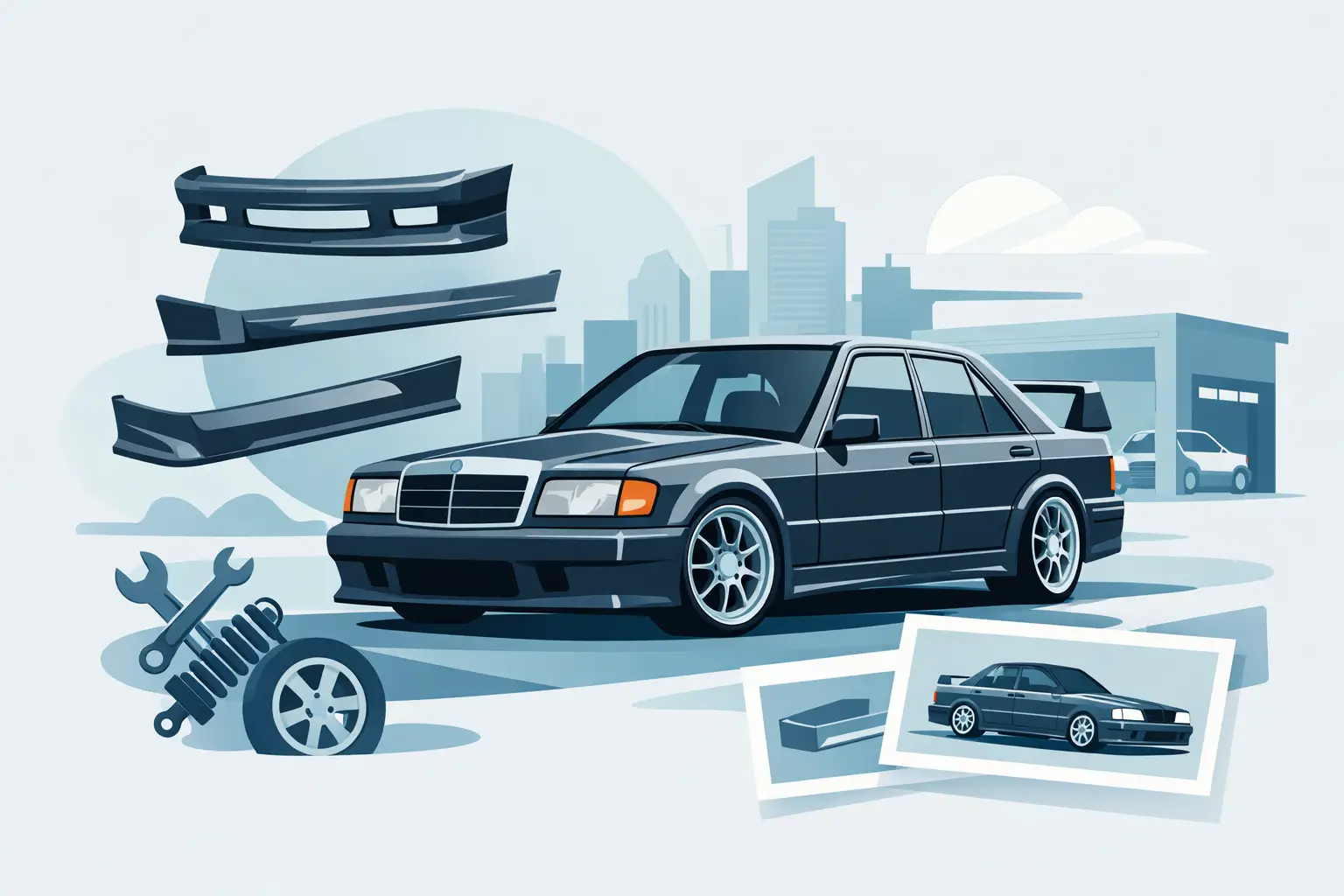
On the W201 Cosworth cars, the exterior package was never just decoration. The deeper front and rear valances, side skirts, and trunk spoiler were designed to support the car’s high-speed stability while defining the visual identity of the 16-valve chassis. On a proper build, those lines should look integrated with the car, not added afterward.
That is why buyers tend to separate these kits into two categories. One is restoration-focused, where the goal is to return a 190E 2.3-16 or 2.5-16 to period-correct condition. The other is conversion-focused, where an owner of a non-16V W201 wants the Cosworth look. Both are valid, but the parts selection is different.
A restoration buyer is usually looking for the closest possible match to original dimensions, mounting points, texture, and trim compatibility. A conversion buyer may accept some adaptation if the overall appearance is right and the kit installs cleanly. The mistake is assuming both buyers need the same product.
Which parts are usually included in a w201 cosworth body kit
A complete kit typically centers on the front lower valance, side skirts, rear lower valance, and rear deck spoiler. Depending on the supplier, you may also see companion pieces such as mounting hardware, clips, seals, or trim-specific accessories needed to finish the installation correctly.
Some kits are sold as true multi-piece sets, while others are assembled from individual exterior components. For many serious buyers, that second option is actually better. It lets you replace damaged sections on an original 16V car without buying duplicate parts, and it gives conversion builds more control over budget and fitment.
Wheel arch treatment is another point to watch. The W201 Cosworth look depends on the relationship between the lower body pieces, ride height, and wheel setup. If the car sits wrong or the wheel fitment is off, even a good kit can look unfinished.
Fitment matters more than price
The biggest difference between a kit that looks factory and one that looks aftermarket is not always the material. It is fitment. Edges should follow the body lines of the W201 cleanly, mounting points should align without forcing the panel, and the final installed shape should not require excessive filler to correct basic geometry.
Low-cost kits often create expensive body shop hours. A front valance that needs trimming, reworking, and reinforcement can erase any savings quickly. That matters even more on a chassis like the W201, where enthusiasts know what the original proportions should look like.
For restorers, panel accuracy is the first filter. For drivers building a tribute or period-style street car, a well-made reproduction may still be the right choice if the contours are correct and the installation burden is reasonable. It depends on the goal of the car, but there is no scenario where poor fitment becomes a bargain.
Original-style appearance vs custom interpretation
Some body kits claim Cosworth styling but take liberties with the shapes. The front lip may be more aggressive, the side skirts may sit too low, or the rear apron may look closer to later tuner-era designs than to the 16V factory profile. If you want a true W201 Cosworth appearance, compare each panel line to known 190E 16V references before you buy.
This is especially important for collectors and resale-conscious owners. A body kit that only loosely resembles original 16V styling can hurt the car’s credibility even if the paint and installation quality are strong.
Material choices and what they mean in the shop
Most buyers will run into fiberglass, ABS-type plastic, polyurethane-style reproductions, or OEM-style construction depending on source and availability. Each has trade-offs.
Fiberglass can work well when the mold quality is high and the installer is experienced. It is common in lower-volume specialty production, but it can arrive needing prep work, edge cleanup, or localized reinforcement. That may be acceptable on a project car, less so on a premium restoration.
Plastic-based panels usually appeal to buyers who want more forgiving street use and a finish closer to factory-style parts behavior. They can be easier to live with on driven cars, but availability is often tighter and pricing may be higher.
What matters most is not choosing by material name alone. Ask how consistent the mold quality is, whether the parts are sold for exact W201 application, and what hardware or trimming work is expected during installation.
Restoration build or 16V-look conversion
A real 190E 2.3-16 or 2.5-16 deserves parts chosen with chassis integrity in mind. If the original body kit pieces are missing or damaged, the priority is to maintain the correct exterior language of the car. That includes matching the spoiler profile, lower trim alignment, and overall stance.
For a non-16V W201 conversion, the standard is different. You are not preserving factory originality, so the key question becomes how cleanly the kit integrates with your specific shell, bumpers, and trim. Some buyers are building tasteful tributes. Others want a period-correct street presentation without representing the car as an original Cosworth model. Both paths can work when the build is honest and the parts are chosen carefully.
The main issue is avoiding half-correct combinations. A convincing conversion usually needs more than just a front spoiler and side skirts. Incomplete styling tends to stand out on the W201.
What to check before you buy
Before ordering, confirm whether the kit is intended for an original 16V application or a broader W201 fitment range. That sounds basic, but it saves time. Small differences in bumper compatibility, mounting details, and trim interfaces can turn a straightforward install into a custom fabrication job.
Look closely at what is included. Some listings show a full exterior setup but ship only the visible panels, leaving hardware and finishing pieces to be sourced separately. That is not always a problem, but serious buyers should know it upfront.
Paint prep should also be part of your budget thinking. Even high-quality reproduction parts usually need test fitting before final paint. Buying painted parts without confirming fit first is rarely the right move on a W201 project.
If you are sourcing for a shop customer, get clarity on intended use. A concours-minded owner, a driver-quality restoration client, and a street build customer are not buying the same product even when they all ask for a W201 Cosworth kit.
Why specialist sourcing matters
This is one of those categories where general aftermarket inventory often falls short. The W201 audience is detail-oriented, and the Cosworth-specific market is even narrower. Buyers want model-correct parts, not broad-fit substitutes presented as close enough.
That is where a specialist catalog makes a difference. A focused Mercedes supplier is more likely to understand the difference between standard W201 exterior parts and 16V-specific body components, and more likely to stock associated pieces that finish the job properly. Mercedes Parts Zone serves that kind of buyer – owners and restorers who need parts that make sense for the chassis, not just parts that can be made to work.
Common mistakes with W201 Cosworth body kit purchases
The first mistake is buying on appearance alone. Product photos can hide waviness, thin layup, or incomplete panel edges. The second is underestimating installation cost. A cheaper kit can become the more expensive option once body shop labor is added.
The third is mixing restoration expectations with conversion pricing. If you want true 16V-level presentation, the budget needs to reflect that. The fourth is ignoring the rest of the car. Suspension height, wheels, trim condition, and paint quality all affect how convincing the finished exterior looks.
A good kit will not fix poor fundamentals, but the right kit on a properly sorted W201 can completely change the car’s presence.
Choosing the right kit for your car
If the goal is preservation, buy the most accurate, model-correct setup you can justify and fit it with patience. If the goal is a clean tribute build, prioritize consistent panel shape, realistic install time, and a complete visual package. If the car is a driver, think about material durability as much as authenticity.
The W201 platform rewards restraint. The best Cosworth-style exterior does not look exaggerated or improvised. It looks like it belongs on the car, because on the right build, it does.
When you are ready to buy, the smartest move is to shop by chassis, application, and finish quality first – and let price come after that.